
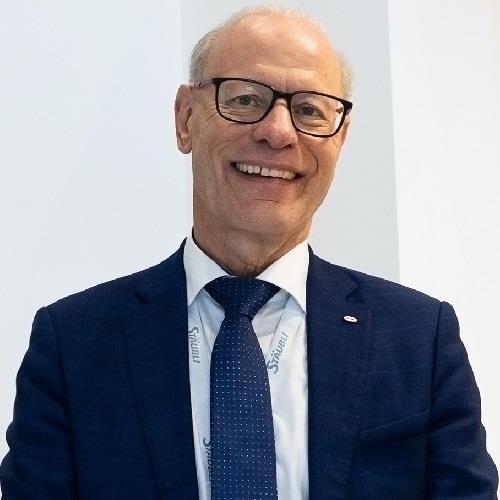
Stäubli is dedicated to performance, automation, and sustainability
With a legacy rooted in innovation since 1892, Stäubli has evolved into a global leader in industrial and mechatronic solutions, with its Textile Division offering advanced systems for high-performance weaving and automation. At the helm of its global marketing, sales, and service operations for weaving preparation systems (WPS) is Fritz Legler—Textile Global Head of Marketing, Sales & Service WPS and Division Marketing Officer. With deep expertise spanning the US, UK, and Asian markets, and a proven track record in sales, product management, and customer service, Legler has played a significant role in expanding Stäubli’s presence in emerging markets such as India and China. In this exclusive interaction with Fibre2Fashion, he shares insights into Stäubli’s innovation strategy, global market dynamics, sustainable manufacturing solutions, and the company’s readiness to meet the future of textile production.
With your extensive global experience across the US, UK, and Asia, how have different regional markets shaped your leadership style in the textile machinery business?
With my extensive experience across the US, UK, and Asia, I have learned that leadership in the textile machinery business must be both globally informed and locally responsive. Each region brings unique market dynamics, customer expectations, and operational challenges. In the US, the focus is often on innovation and automation; in the UK, precision and heritage play a strong role; while in Asia, adaptability and speed-to-market are key.
These differences have shaped my leadership style to be agile, culturally aware, and deeply customer-centric—ensuring that Stäubli’s solutions are not only technically advanced but also aligned with the specific needs of each market.
From your viewpoint, how is the textile industry evolving on a global scale, particularly with the growing emphasis on automation and sustainability?
From my perspective, the global textile industry is evolving rapidly, driven by the dual imperatives of automation and sustainability. These forces are helping manufacturers overcome persistent challenges such as labour shortages and the need for faster, more efficient production.
At Stäubli, we are deeply committed to addressing these needs through high-performance solutions. Our ‘SAFIR PRO series of automatic drawing-in machines’ ensures flawless harness preparation, boosting efficiency while reducing carbon emissions. Meanwhile, our ‘Jacquard machine PRO series’ is engineered with robust materials and innovative design, enabling high-quality fabric production with up to 30 per cent lower energy consumption—a major step towards sustainable manufacturing.
By embracing these technologies, weaving mills can significantly enhance productivity and environmental responsibility—two pillars that are reshaping the future of textiles.
Stäubli has a legacy dating back to 1892. How has the Textile Division continually adapted to remain a trusted partner for textile manufacturers worldwide?
At Stäubli, we believe that our customers are not just machinery purchasers but partners with whom we build a sustainable future. Through continuous R&D and ongoing machinery optimisation, we offer a broad portfolio of weaving solutions tailored to nearly every industrial sector, for example, aerospace, automotive, and apparel.
To support our customers throughout the entire lifecycle of their machines, we have established local service teams composed of trained technical experts in over 19 countries worldwide. This proximity allows us to respond swiftly to market needs while developing a deep understanding of local dynamics.
Our commitment to proximity and responsiveness enables us to cultivate strong, long-lasting partnerships with customers around the globe— founded on trust, innovation, and shared success.
Stäubli is exhibiting at ITMA Asia + CITME 2025 in Singapore this October. What key achievements or solutions will the company showcase at the event?
Our focus is on high-speed solutions that support all types of weft insertion and meet the demands of major applications in Asian weaving operations.
During the exhibition in Singapore, we will be showcasing the following innovations:
- SAFIR PRO S37: a new automatic drawing-in machine for filament yarns, delivering significantly higher speed and performance with advanced yarn handling for maximum efficiency.
- Electronic rotary dobby S3280: dedicated to air-jet weaving machines, offering high-speed performance of up to 1,200 rpm.
In addition, we will present other advanced technologies including the LX PRO Jacquard machine, the TIEPRO warp knotting machine, and the rotary dobby S3017/S3018 for water-jet applications.
These solutions reflect Stäubli’s ongoing dedication to performance, automation, and sustainability— empowering weavers to achieve greater productivity while reducing environmental impact.
How does Stäubli ensure that its services—be it technical support or after-sales care—remain responsive across diverse global markets?
Stäubli ensures responsive global service through its intuitive MyStäubli portal, which supports customers throughout their machine’s lifecycle. The platform provides key performance indicators of the machine’s health, maintenance tracking, incident reporting, and active diagnostics to help prevent downtime. With the integrated spare parts e-shop, customers can easily search for components, view pricing and stock availability, and manage orders efficiently. By combining digital tools with localised expertise, Stäubli delivers fast, informed support— ensuring that its services remain agile and effective across diverse textile markets worldwide.
Training is crucial in operating advanced textile machinery. How does Stäubli support mills in building skilled manpower for efficient machine handling?
At Stäubli, our approach to training is rooted in simplifying complexity. We believe that empowering mills with intuitive, easy-to-operate machinery is key to building skilled manpower efficiently. By reducing the learning curve, we help customers minimise training time and costs while accelerating operational readiness. This strategy is especially valuable in today’s fast-paced textile environment, where responsiveness and productivity are critical.
To support this, we offer user-friendly solutions such as the ‘SAFIR PRO series’ and the ‘TIEPRO warp knotting machine’. These machines are designed to reduce downtime and enhance efficiency. For instance, a greige fabric producer in Indonesia— the first in the country to adopt the TIEPRO—reported excellent results in handling diverse yarns and designs, with low maintenance needs and reduced operating costs. This led to a significant boost in productivity.
Emerging markets like India and Vietnam continue to grow. How does Stäubli tailor its solutions to cater to the specific demands of these regions?
Stäubli addresses the unique needs of emerging markets like India and Vietnam by offering solutions that significantly reduce Total Cost of Ownership (TCO). This includes short training time for operators, lower energy consumption, minimal maintenance and downtime, and a high resale value—all critical for fast-growing textile sectors with cost-sensitive operations.
A prime example is our LX PRO Jacquard machine, designed for high-speed weaving with exceptional reliability. It ensures quick operator onboarding, consumes less energy, and requires minimal servicing— making it ideal for dynamic production environments. Its robust build and performance also guarantee strong resale value, aligning perfectly with regional demands.
Technical textiles are gaining traction globally. What role is Stäubli playing in enabling production of these advanced fabrics?
Technical textiles are rapidly advancing across industries, and Stäubli plays a key role by delivering high-performance weaving solutions tailored to these demands. Our state-of-the-art machinery ensures precision, reliability, and adaptability for sectors such as aeronautics, automotive, and medical. The ‘TF30 weaving system’ excels in handling heavy multilayer fabrics and 3D reinforcement textiles made from sensitive materials like carbon, glass, or aramid. Complementary solutions include ‘LXL PRO’ for one-piece woven airbags, ‘ALPHA 580 UNIVERSAL Schönherr’ for lightweight aeronautic carpets, and ‘SAFIR PRO S37’ for fiberglass yarns in printed circuit boards. These systems are continuously refined to meet the rigorous standards of technical yarns.
DISCLAIMER: All views and opinions expressed in this column are solely of the interviewee, and they do not reflect in any way the opinion of Fibre2Fashion.com.
link