

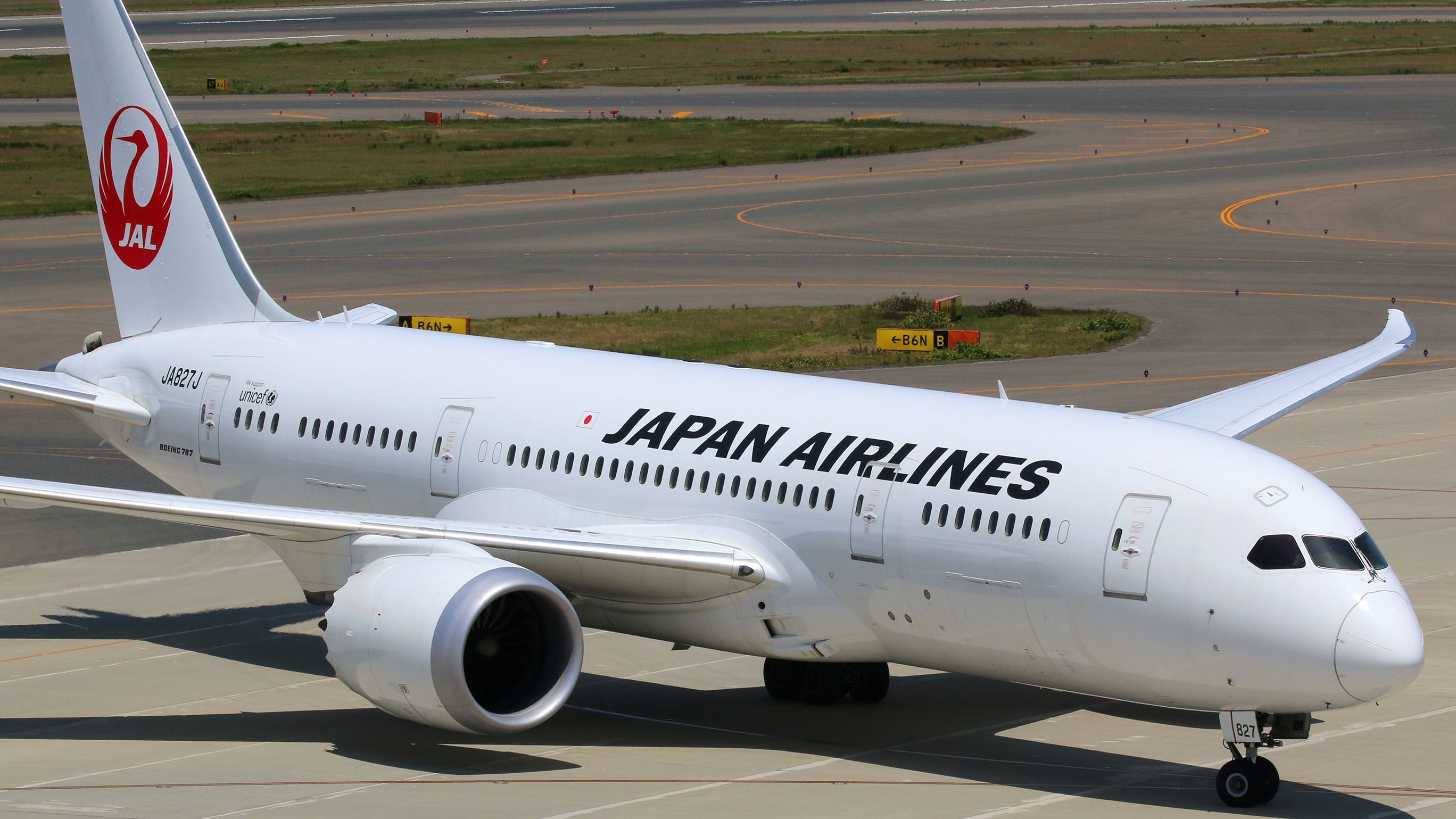
Japan Airlines (JAL) is one of Japan’s leading carriers, serving a variety of destinations worldwide from its Tokyo hub. The airline is consistently ranked high for customer experience and satisfaction, and it has continued to innovate to create more pleasant and efficient operations. In fact, just last month, it announced same-day baggage delivery to Tokyo hotels for passengers.
However, its most recent improvement does not impact the passenger experience. In fact, most passengers may not be aware of it at all when they fly. The airline is covering one of its Boeing 787-9 Dreamliners in a riblet-shaped coating and will be the first carrier to fly internationally using a plane with this material.
Riblet-shaped coating improves efficiency
Riblets are a structure consisting of fine grooves. Interestingly, the concept was developed with inspiration from shark skin. If the grooves featured on a riblet structure are in the same direction as the airflow on an aircraft in flight, they can reduce resistance and thus improve efficiency.

Photo: O-Well
According to JAXA, this new coating is part of Japan Airlines’ larger effort to decarbonize aviation. The riblet-shaped coating was applied using the Paint-to-Paint method, which, patented by Japanese corporations O-Well and JAXA, involves using a water-soluble mold to form irregularities on existing paint.
Unlike riblet processing that uses decals or films, the Paint-to-Paint method allows the riblet to be applied to the fuselage directly. This is expected to improve durability and reduce weight compared to existing application methods.

Photo: KITTIKUN YOKSAP | Shutterstock
The durability of riblet-shaped coats has already been proven thanks to deployment on parts of Japan Airlines’ short-haul fleet of Boeing 737 aircraft. The technology was tested between July 2022 and November 2023, when a large area of the aircraft’s lower fuselage was equipped with the new coating to confirm that it would enhance fuel efficiency.
Now, the coating will be applied to one of Japan Airlines’ Boeing 787-9 Dreamliners, which is deployed on international routes in the airline’s network. Research and manufacturing done by Japan Airlines’ partners JAXA and O-Well made this possible.

Photo: Vincenzo Pace | Simple Flying
Wind tunnel tests performed by JAXA using a model Boeing 787-9 fuselage revealed a notable reduction in drag on the aircraft. Meanwhile, O-Well developed a riblet coating system capable of handling larger aircraft like the Dreamliner.
Japan Airlines reports that the aircraft that received this new coating boasts a drag reduction of 0.24% at cruising altitude. The airline expects the latest technology to reduce CO2 emissions by 381 tons and fuel consumption by 119 tons annually. These savings were estimated using fuel consumption estimates based on JAL’s Tokyo Narita to Frankfurt route. JAXA calculated the drag reduction rate.

Related
Which Destination Should Japan Airlines Add In The US?
Japan Airlines, commonly known as JAL, is Japan’s flag carrier. The airline is a member of the oneworld Alliance and flies to a range of destinations in the United States. Its existing route network covers Boston, Chicago, Dallas/Fort Worth, New York, and several west coast cities.
The airline recently introduced a new credit card in the United States, which could potentially indicate the airline is looking to expand its US presence. Where are some of the destinations or routes you could see JAL flying in the future? Should it stick to oneworld hubs like Seattle-Tacoma or branch out into smaller gateways like Phoenix? Let us know your thoughts in the comments.
Japan Airlines’ fleet
Japan Airlines is a leading force in the Asian aviation industry. According to JAL, the carrier boasts a fleet of 227 aircraft deployed on both domestic routes throughout Japan and on international services as far as Europe and the United States. The airline’s largest fleet is of Boeing 737-800 aircraft, of which it has 62. 47 of these are owned by the airline, and 15 are leased from other parties.

However, the airline operates other narrowbody aircraft. Two Airbus A321s are leased and used on short-haul flights, and JAL also operates many regional jets to support its short-haul network: the Embraer E170, Embraer E190, DeHavilland DHC-8-400 Cargo Combi, ATR42-600, and ATR72-600. Except for one ATR42-600, the airline owns its entire regional fleet.
Meanwhile, the airline also operates a robust fleet of widebody aircraft, though these giants are not always used on international routes. Japanese airlines are notorious for deploying high-density widebody planes on short-haul domestic routes to account for the massive demand between Japanese cities.

The airline operates the Boeing 767-300, 777-200ER/-300ER, Boeing 787-8/-9, and Airbus A350-900/-1000. Japan Airlines is one of the largest operators of Airbus’ newest widebody plane, and it deploys it on various routes across Japan and the world. Many of the A350’s top routes for JAL are domestic and usually from the airline’s hub at Tokyo Haneda International Airport.
link