
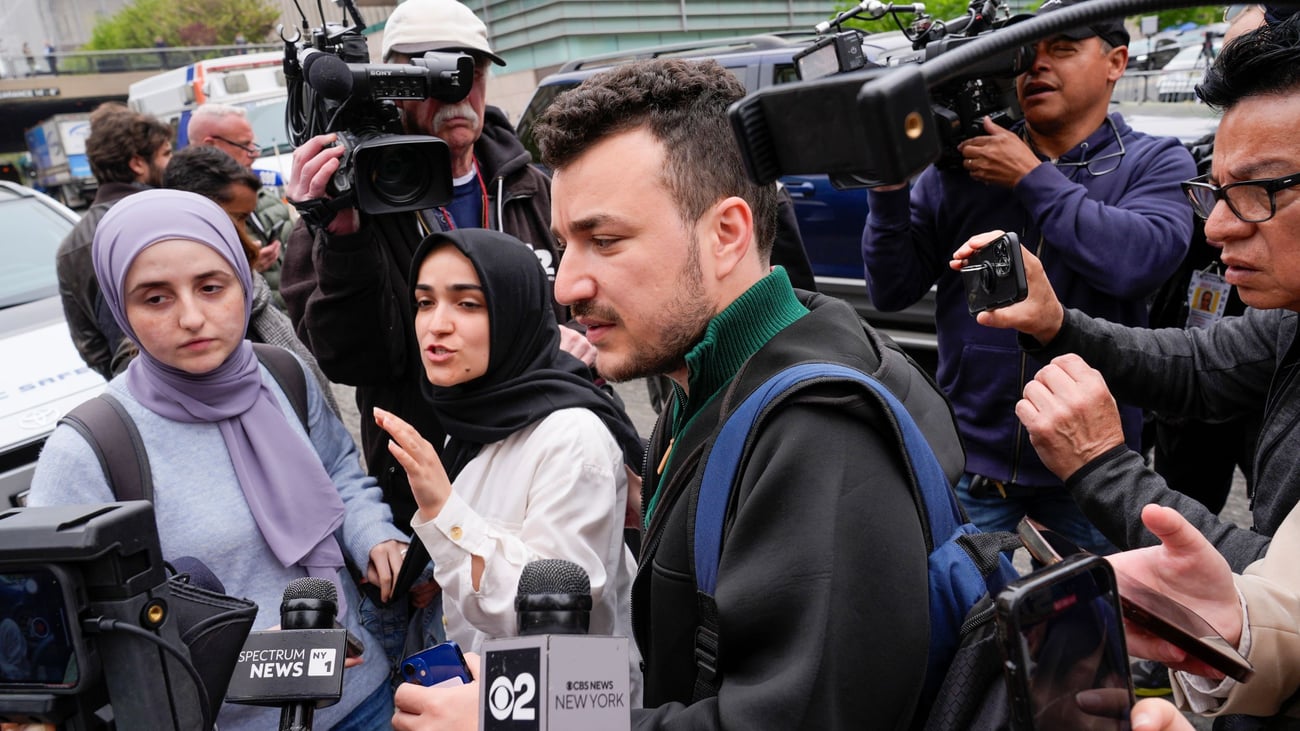
Khalil will have to alert ICE officials of his travel plans two days in advance, a federal magistrate judge in New Jersey ruled.
(CN) — Palestinian activist Mahmoud Khalil can now move freely throughout the United States as he awaits his removal proceedings, a magistrate judge ruled Thursday, freeing him up for potential speaking engagements and advocacy work around the country.
U.S. Magistrate Judge Michael Hammer made the call roughly four months after Khalil — a former Columbia University student whose campus activism made him a target of the Trump administration — was freed from federal immigration custody.
His bail conditions previously confined him to his home state of New York, except for specific circumstances like to visit family in Michigan or to attend immigration court appearances in Louisiana. But Khalil sought to lift those restrictions to more freely visit loved ones and take advantage of professional opportunities.
“For example, he has been invited by Yale Law School students to participate in a forum in early November, as his experiences and perspective have generated strong interest on issues of serious public concern,” Khalil argued in a court filing, claiming that the travel restrictions breached his right to free speech.
In finding that Khalil has been nothing less than “fully compliant” with his bail requirements this far, Hammer granted the request from the bench on Thursday — with the caveat that Khalil needs to alert Immigration and Customs Enforcement of any interstate travel 48 hours ahead of time.
“Merely providing basic travel information, the logistics, is a minor task,” Hammer wrote. “I do not find that it unduly restricts Mr. Khalil’s speech.”
Hammer clarified that Khalil is in no way required to give a reason for or justify his travel to ICE officials — he only needs to alert them where and when he will be traveling should he be subject to a final order of removal.
“The location information satisfies that interest,” Hammer said. “The government has no further need for information about Mr. Khalil beyond that. I find that requiring him to give specific information would start to intrude or potentially chill the exercise of his First Amendment rights.”
Prior to Hammer issuing his bench order, Justice Department attorney Aniello DeSimone unsuccessfully argued that Khalil failed to “provide enough information” about the necessity of his travel to justify changing his bail requirements.
The government also tried to argue that Khalil, who was never deemed a flight risk nor a danger to the community, should be subjected to GPS monitoring if allowed to travel. Hammer rejected that bid, too, finding “no basis” to impose it.
Alina Das of New York University’s Immigrant Rights Clinic represented Khalil at the oral arguments.
Khalil is still barred from international travel and is required to attend all of his upcoming immigration court proceedings.
A lawful permanent resident with a green card, Khalil was arrested earlier this year by ICE agents after the State Department deemed his pro-Palestinian advocacy a national security threat. Since then, the Trump administration has been citing a rarely used provision in federal law — which allows the government to revoke the residency of those who endanger U.S. foreign policy — in its ongoing effort to deport Khalil to Syria.
Khalil is one step closer to that reality; U.S. Immigration Judge Jamee Comans ruled last month that he can be removed on that basis. But he’s currently protected from deportation by a federal judge in New Jersey, where Khalil filed a habeas corpus petition after his arrest.
That protection expires at the end of the habeas case, however, meaning Khalil may be forced to leave his wife and newborn child in New York City in the coming months.
Khalil says he was targeted by the Trump administration for his leadership role at Columbia University’s pro-Palestine demonstrations last spring. Then a graduate student, Khalil was a lead negotiator for student protestors, who sought to get Columbia to divest assets from Israel amid its bombing campaign in the Gaza Strip.
He’s one of several other students and lawful residents who have been swept up by ICE for their participation in similar movements around the country. Thus far, none of their detentions have been justified by federal courts.
Subscribe to Closing Arguments
Sign up for new weekly newsletter Closing Arguments to get the latest about ongoing trials, major litigation and hot cases and rulings in courthouses around the U.S. and the world.

link