


Business travel in the small and
midsize segment looks to be holding up a bit better than in the larger
corporate segment in the first 6 months of 2025, according to a BTN
Intelligence survey of 155 business travel buyers in the SME space. BTN defines
the SME travel program as companies with total annual travel and entertainment
spend volume below $25 million.
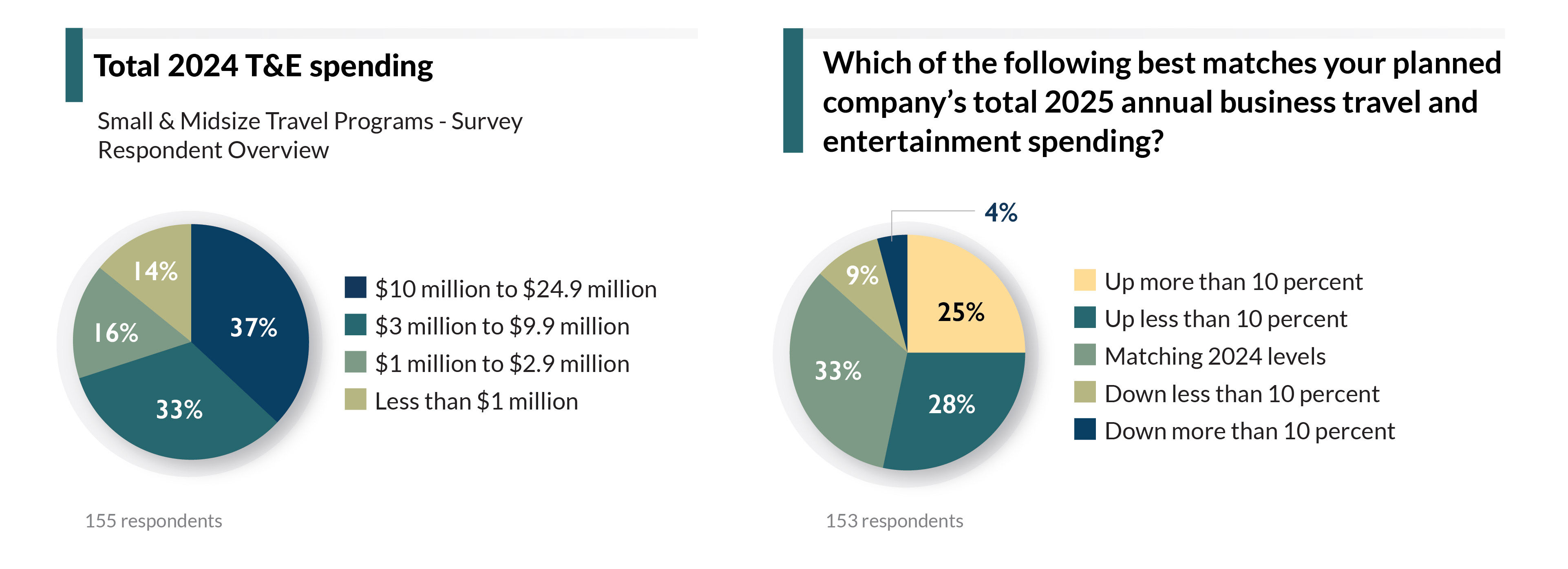
Respondents to the survey fell
roughly into three segments: 30 percent spending less than $3 million in 2024,
33 percent spending $3 million to $9.9 million last year and 37 percent
spending $10 million to $24.9 million.
Across these spending levels, more
than half told BTN their company’s planned 2025 travel spend was higher than
their actual 2024 spend. A quarter of respondents estimated 2025 travel spend
volumes up more than 10 percent, while 28 percent said they were up, but by
less than 10 percent over 2024 levels. One third estimated their companies’ travel
spend volumes would be flat year on year, and only 13 percent of respondents
said spend would drop compared to last year.
That was bright news in a year
when government policy volatility and tariff whiplash has buffeted industry
with ongoing economic and geopolitical uncertainty. And it’s a better showing
than the industry overall, which BTN surveyed just a few weeks prior.
The earlier, full industry survey
showed 30 percent of 145 responding companies expecting a decrease
in their 2025 business travel spending. That was after a rough week of
geopolitical news that included tariff “liberation day” in which the U.S. administration
declared massive duties on imports from all trading partners (many of which
have since been partially rescinded or suspended) as well as narratives of
increased screening tactics at border crossings, including scrutiny of and denied
entrance to foreign nationals based on social media activity and minor legal
infractions, as the U.S. applies pressure to its international relations on
several fronts.
For small and midsize businesses,
those specific issues are weighing less heavily on business travel
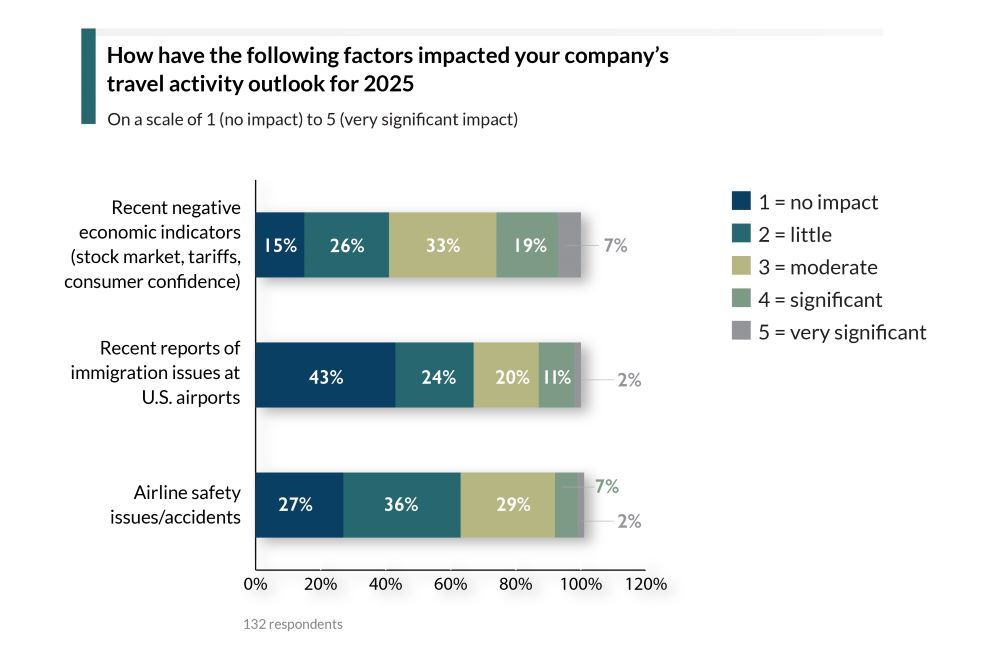
decision-making. Slightly more than 40 percent of survey respondents told BTN
that recent negative economic indicators have had little to no effect on their
company’s travel activity outlook for the remainder of 2025. Fully two-thirds
have said the same about recent reports of immigration issues at U.S. airports.
SME Numbers Track with Supplier
Perspectives
While the industry is deep into
the second quarter of business for 2025, suppliers in their first-quarter earnings
calls remarked on the softening in the travel sector—not just in business
travel, but in the sector overall. Airlines were reticent to project earnings
expectations for the full year, after several major carriers downgraded
their projections in early March.
But several suppliers have
remarked on the durability of the SME market even in the most volatile moments.
“We’ve seen … very little
impact on the SMB business because these folks got to get out and run their
business, and they’re not going to be as quick to make decisions… [there’s] a
little bit more [impact] on the big corporates,” Hilton CEO Christopher Nassetta
said during the company’s first quarter earnings call at the end of April.
Best Western CEO Larry Cuculic
backed up Nassetta’s statement with another six weeks on the results radar. He spoke
with BTN at the beginning of June and said the hotel company had been focusing
much of its effort on its small and midsize program Best Western Business
Advantage, and that the book of business for that program had not been
impacted. “[SMEs] don’t cut as quickly as the large corporations might, because
they’re still doing business the way they have to do business,” he offered. “The
small and medium enterprise business has not been, I think, as impacted as
large corporate business travel.”
Some of that SME business for
Hilton and Best Western may not have formal travel management company relationships,
though most of BTN’s survey respondents do, whether working with big players
like American Express Global Business Travel or new entrants like Navan or TravelPerk.
How those companies are strategically managing their travel may be different
than those companies with more less of bead on how travel supports business
growth but also comes through as an upfront expense.
SME specialist TMC AmTrav—acquired
by TravelPerk last year—continues to watch the numbers closely. CEO Jeff Klee
spoke to Business Travel News in June and noted a relatively small discrepancy
in May numbers. He says it would be premature, however, to identify any kind of
trend.
“Up until a few days ago, there
were some anecdotal things of maybe some accounts trying to cut back on travel
or get stricter on policy before tariffs [kicked in]. But as far as hard data
through April, nothing looked different,” he said.
“In May we did a comparison of
existing accounts that had been with us for at least a year, and we did see a
drop of like a mid-single digit percentage. That’s not insignificant, so we’re
paying attention to it to figure out, ‘is this a trend or is this a blip?’ and
we just need another month to understand more.”
The Minority Report
While clearly a minority—and one
that may be offset by increases experienced by more bullish organizations—BTN
data showed a full 26 percent of surveyed SME business travel buyers managing programs
that have been significantly or very significantly impacted by recent economic swings.
Whether that means they were planning for higher budgets and had to cut back to
flat budgets year over year or went from flat budgets into reductions for their
travel programs can’t be pinpointed by the data in BTN’s survey.
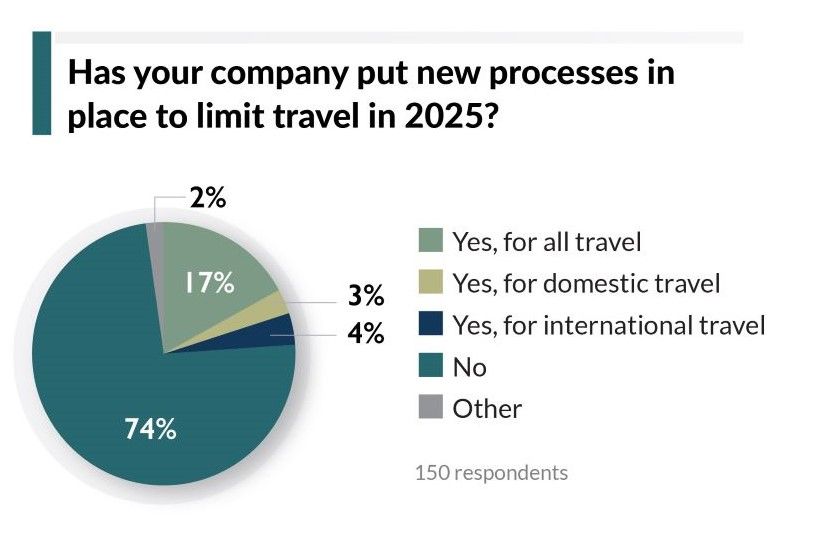
The same
percentage indicated their companies have put new processes in place to limit
travel in 2025. It’s worth noting here that these may not be the same
companies, despite the one-to-one appearance of the data point. Plenty of
companies with rising budgets may be putting new policies in place to limit
travel, as travel costs are rising significantly and many companies noted in
BTN’s survey that they are struggling to keep even their higher budgets in check.
Certainly, however, small and
midsize companies cutting back on travel spend may need to include new, more
restrictive controls around what travel is approved and what travel isn’t. One SME
buyer, in an open response field in BTN’s survey wrote, “We work in private equity,
so any tariffs, travel restrictions, etc., could have a huge impact on the
investment industry. This will ultimately affect our travel program.” Another
buyer was much more specific. “We have to cut all travel budgets by 40 percent due to the tariff crisis,”
they wrote. “Prioritizing what travel and what meetings will or will not be
held has been a very big challenge.”
Some buyers based in the U.S.,
however, have shared that some of the shifts that impacted them most were those
induced
by government spending reduction—or at least the threat of it. And it’s not
just spending directly budgeted for travel but also for more general-purpose funding
for education and research institutions. “We are a university that relies
heavily on federal funding, and the uncertainty [at the government level] has
caused a lot of issues for our travel program.”
In terms of tightening travel processes, spend
management was not the only concern among BTN’s SME respondent base. One buyer
noted their company now requires “pre-trip approvals from overseas management
at two levels” in order for overseas employees to travel to the United States.
SMEs Show Confidence in Travel Management
While 25 percent should not be considered “edge case”
in terms of having real challenges to their travel programs, the vast majority
of SME survey respondents projected confidence in their programs despite
challenges.
At the smaller end of the spend spectrum, a number of
buyers told BTN they were managing travel for the first time and are eager to
pull the right levers to optimize the benefits for their businesses.
One said: “We are currently implementing a T&E tool
and a travel policy and we will go from a complete unmanaged program to a fully
managed one with mandatory use of the OBT.” Another buyer said their small
travel program of less than $3 million in spend annually had been in place for
a year and was ready for next steps.
“We started our managed travel program in 2024 and
implemented an online booking tool, a first for the organization,” the buyer wrote.
“In 2025, I need to show the value of the program and relationship with the
TMC. We also need to tackle the final 25 percent of non-compliant participation
in the program.”
More experienced SME program managers showed a
mounting level of sophistication, citing New Distribution Capability adoption
and diversification of content channels, elevated sourcing strategies and
awareness of data analytics to drive their programs. While those just moving
into managed travel were getting the basics in place, SME buyers with years behind
them, are clearly seeing a changing industry and the need to flex their
programs and models to tackle the changing reality for their travelers.
link