

I have been writing about the challenges facing the digital travel world since the introduction of airline retailing, both in terms of user experience and scalability/sustainability.
Now would be a good time to propose a way forward to address these issues, based on my many years working with airlines and global distribution systems (GDSs) but also all the challenges I faced working on innovation projects with online travel players—online travel agencies (OTAs), metasearch and tour operators—around the globe over the past couple of years.
Some of these conversations are already taking place behind closed doors between individual players. I hope this article will trigger a broader discussion and productive collaboration across the industry, which is critically lacking at this stage of the airline retailing transformation journey.
Looking ahead but learning from the past
The travel industry is undergoing a transformative shift, driven by the need for more efficient and innovative airline offer distribution across all sales channels.
The adoption of New Distribution Capability (NDC) is a major step in the airline transformation journey, but its roll-out is still facing significant hurdles. Inefficient offer processing results in dynamic pricing benefits being offset by high computing costs. Many channel requirements remain unaddressed, particularly for complex trips, tour packages and discovery/inspiration use cases.
Subscribe to our newsletter below
NDC suffers from both technical and functional scalability limitations. The airline retailing transformation is likely to stall at some point due to the lack of comprehensive and future-proof flight search technology solutions.
To overcome these challenges, airlines need a streamlined offer distribution model that keeps them in control of offer creation and distribution channels—across direct API partners, flight aggregators and GDS. At the same time, digital sales channels need a solution that brings innovation back to the travel funnel with artificial intelligence (AI)-powered flight search technology tailored to a broad set of business needs.
The “offer distribution platform” concept could be the solution to address the limitations of current API-based distribution models while enabling the generative AI use cases that will drive the next round of flight search technology evolution. This proposed architecture would reshape travel distribution by empowering airlines and travel sellers with optimized supply, advanced functionalities and sustainable practices
A disruptive yet compatible solution
The offer distribution platform introduces a new approach to airline offer distribution by addressing the limitations of current systems and enabling advanced functionalities across channels. It boosts airline retailing adoption by providing access to more channels, content and use cases while optimizing computing costs and reducing the carbon footprint of the travel supply chain.
The proposed design ensures airlines retain control over their retailing strategies and offer creation processes while powering efficient and innovative flight search capabilities for all channels. This allows airlines to make their offers accessible for diverse use cases such as calendar searches, map-based searches, virtual interlining and tour packages—all without disrupting existing booking and order creation flows.
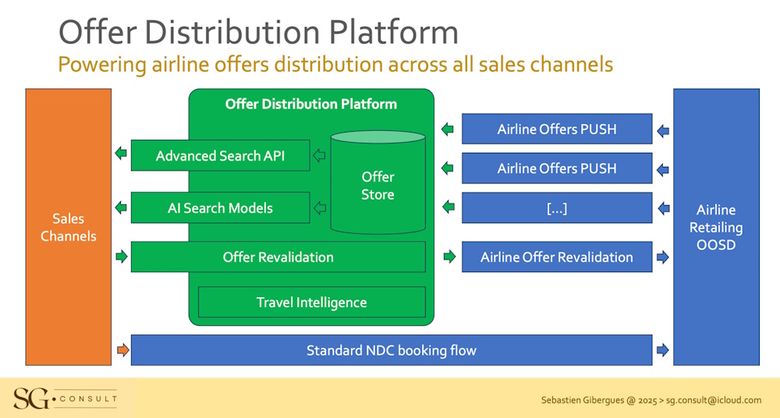
The offer distribution platform is architected around two main components:
- An “offer store” that consolidates offers from all participating airlines; these “lead offers” are generated by each airline retailing system and made available to approved channels.
- An “offer revalidation” API allowing lead offers to be sent back to the airline retailing system to:
- 1) Dynamically confirm price
- 2) Generate a valid NDC offer that will be used to complete the NDC booking process
- 3) Propose alternative offers with personalized upsell or cross-sell bundles.
As users progress down the search funnel, offer store-powered searches will enable fast and efficient processing of airline lead offers. As soon as an individual user requires more specific and personalized airline offers, the revalidation API will enable full dynamic pricing, upsell and personalization from the airline retailing system.
Once the user has selected the right offer for the journey, the booking process will continue down the standard NDC API path. The standard NDC AirShopping flow remains available to the channels for traditional or long-tail searches, not powered by the offer store.

Value proposition for airlines
The offer distribution platform provides airlines with several benefits that align with their retailing transformation strategy.
By joining the platform, airlines can eliminate NDC polling costs and transition to a more predictable cost model that shifts part of search traffic processing back to distribution channels. This architecture also allows airlines to extend the reach of their NDC offers to more channels and use cases without compromising control over their offers.
Airlines will work more efficiently with their distribution partners across metasearch engines, OTAs, tour operators and travel management companies (TMCs). The platform empowers airlines to fully leverage their NDC investments while expanding proven travel industry practices.
This streamlined architecture ensures scalability without disrupting existing booking systems or sales channels, powering the next decades of travel distribution through offer and order transformation.
Value proposition for channels
With the offer distribution platform, digital travel sellers will gain unrestricted technical access to NDC offers across all channels and flight search use cases without functional constraints imposed by individual airline APIs. This eliminates reliance on outdated caching methods or workarounds that hinder innovation.
The platform enables travel sellers to implement advanced functionalities such as calendar searches, map-based searches, virtual interlining and tour packages seamlessly.
More importantly, this new architecture will make it possible to create airline offer data lakes that can be used to train large language models, creating new flight search capabilities tailored to future consumer needs. By removing scalability limitations and boosting innovation opportunities, digital travel sellers will be able to kick off a new phase of digital travel innovation across all channels.
Open deployment and business models
The offer distribution platform proposes a sustainable technical architecture designed to benefit both airlines and travel sellers. Several business models can be considered, but it would be most appropriate to align the money flow with value: Airlines are onboarded through a flat subscription fee structure that eliminates most polling traffic and optimizes costs. Travel sellers are charged on a pay-per-use basis, ensuring scalability without unnecessary overheads.
Offer distribution platforms can be replicated across the industry to keep a competitive landscape. Any intermediary—industry bodies (OAG, ATPCO), GDS or aggregators—could launch competing offer distribution platform solutions, while specific large travel players may build their own in-house offer distribution platform. Some of these platforms may be standalone flight search services, separate from existing “booking” distribution agreements.
This model leverages proven industry frameworks while aligning with key airline retailing transformation principles. By powering the travel supply chain with efficiency and sustainability at its core, the platform aims to drive innovation for the next decades while contributing to travel sustainability goals.
Conclusion: Unlocking innovation for the next 20 years
The offer distribution platform proposal represents a bold step forward in addressing inefficiencies in airline offer distribution while embracing generative AI-driven innovation.
By empowering airlines to regain control over their retailing strategies and enabling travel sellers to scale NDC adoption seamlessly across diverse use cases, this architecture has the potential to redefine how flight search technology innovates across channels.
As the travel industry continues its transformation journey, offer distribution platforms will play a pivotal role in shaping a more sustainable, efficient and customer-centric future. This is not just an advancement in technology—it’s a vision for how travel distribution can evolve to meet the needs of tomorrow’s travelers while driving innovation across the travel supply chain.
About the author…
link